Resume Parsing API: Extract CV Data to JSON Automatically
Parse resumes and CVs into structured JSON automatically. Name, skills, work experience, education, and certifications extracted and ready for your ATS or HR system.
Start in minutes
Best fit for
HR teams, recruitment platforms, ATS integrations, and talent acquisition workflows that need structured candidate data at scale.
API documentationNo manual entry
Replace manual CV keying with a single API call and a reusable extraction template.
Any CV format
PDF, Word documents, scanned CVs, and even creative multi-column layouts processed through the same API.
ATS-ready output
Structured JSON maps directly to candidate fields in any ATS or HRIS without transformation.
What is resume parsing?
Resume parsing is the automated extraction of structured data from CVs and resumes, including candidate name, contact details, work experience, education, skills, and certifications. It eliminates manual data entry and delivers clean JSON ready for import into any ATS, HRIS, or talent database.
Parselyze provides a resume parsing API that converts PDFs, Word documents, and scanned CVs into structured JSON in seconds. Unlike rule-based parsers that break on non-standard layouts, Parselyze uses AI extraction to handle any format, language, or structure reliably.
How to parse resumes to JSON
Upload any CV or resume document and receive structured JSON automatically. No template configuration required for standard resumes.
Upload the resume
PDF or image. Works with any layout, language, or CV format.
Parselyze extracts all fields
Name, contact info, skills, experience, education, and certifications extracted automatically.
Structured JSON returned
Push candidate data directly to your ATS, HRIS, or talent database.
Resume to JSON: extraction output example
This is the structured JSON your application receives from a CV parsing request.
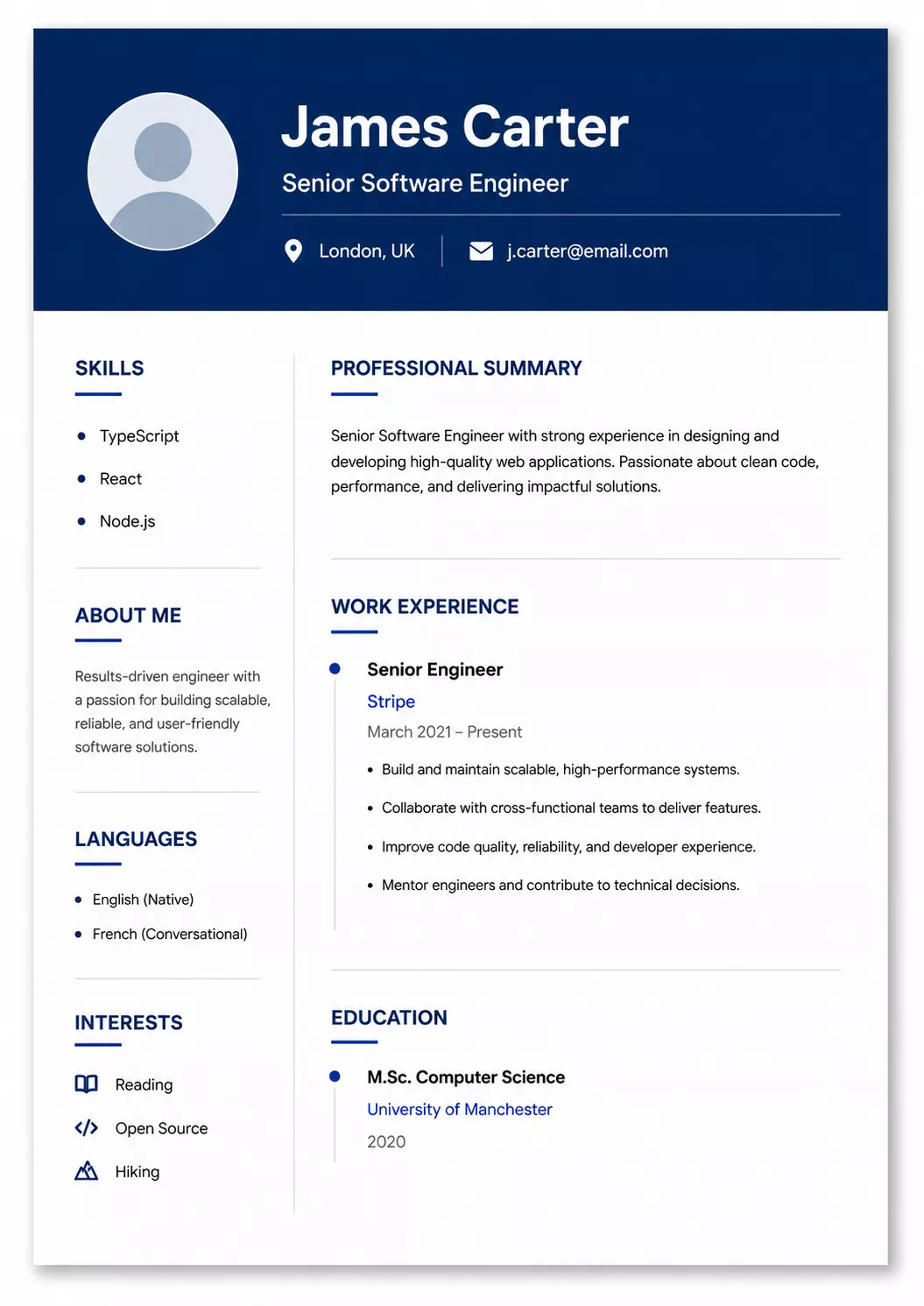
{
  "first_name":  "James",
  "last_name":   "Carter",
  "email":       "j.carter@email.com",
  "location":    "London, UK",
  "skills": [
    "TypeScript", "React", "Node.js"
  ],
  "work_experience": [{
    "job_title":  "Senior Engineer",
    "company":    "Stripe",
    "start_date": "2021-03",
    "end_date":   "present"
  }],
  "education": [{
    "degree":      "M.Sc. Computer Science",
    "institution": "University of Manchester",
    "end_date":    "2020"
  }]
}
Typical workflows
ATS Integration
Feed structured candidate data directly into your applicant tracking system without manual entry.
Candidate Screening
Extract and index skills, seniority, and experience to automate initial screening and shortlisting.
Talent Database
Build a searchable talent pool by parsing and storing structured CV data at scale.
HR Onboarding
Pre-fill onboarding forms and employee records from a candidate's resume automatically.
Add resume parsing to any app
Install the SDK, import the resume template, and submit your first CV. Candidate data is returned as structured JSON you can immediately push to your ATS or HRIS.
npm install parselyzeReady to integrate?
REST API reference, SDK examples, bulk processing guide, and webhook handler docs available on the developer page.
Fields extracted when you parse a resume to JSON
Standard candidate fields returned as structured JSON with every request.
Frequently asked questions
Everything you need to know about resume parsing.
What is resume parsing?
Resume parsing is the automated extraction of structured data from CVs and resumes, including candidate name, contact details, work experience, education, skills, and certifications. The result is structured JSON ready for import into an ATS or HR system.
What file formats are supported for resume parsing?
Parselyze processes PDF, PNG, JPG, WEBP, and scanned resume images. Any resume format that can be rendered as an image or PDF is supported.
How accurate is resume parsing for complex CVs?
Parselyze uses AI-based extraction rather than rule-based parsing, so it handles diverse layouts, multi-column formats, and non-standard section headings reliably without custom configuration per template.
Can I parse resumes in bulk?
Yes. Parselyze supports async document processing and multi-file submissions. You can submit batches of resumes and receive results via webhook when each job completes.
Does resume parsing integrate with ATS platforms?
Yes. The structured JSON returned by Parselyze can be mapped directly to ATS fields in platforms like Lever, Greenhouse, Workable, or any custom HRIS via their APIs or automation tools like Zapier.
Can Parselyze extract skills and language proficiency levels?
Yes. The resume template extracts a list of skills and, where stated, language proficiency levels. Custom fields can also be added to the template to capture any domain-specific information present in the CV.